The Most Popular Diamond Shapes in 2026
The Most Popular Diamond Shapes for Your Engagement Ring
No matter what style of engagement ring you choose, the center diamond is almost always the focal point. It sets the tone for everything else — the setting, the metal, the overall feel — so it's worth taking the time to find a shape you genuinely love. And that decision starts with understanding your options.
Diamond Cut vs. Diamond Shape
Before we dive in, it helps to clarify a common mix-up. The terms "diamond cut" and "diamond shape" are often used interchangeably, but they actually mean different things. The cut refers to how well a diamond has been crafted — its angles, proportions, and symmetry — which directly determines how much it sparkles. The shape refers to the diamond's overall outline: round, oval, pear, and so on. Cut is one of the 4 Cs of diamond grading and has the biggest impact on brilliance. Shape is more of a personal style choice. Both matter, and a good jeweler will help you think through both.
The Most Popular Diamond Shapes in 2026
Round
For decades, the round brilliant has been the most popular diamond shape for engagement rings, and it earns that standing. The round brilliant cut was designed with one purpose: to return as much light as possible. With 57 or 58 precisely angled facets, a well-cut round diamond reflects light with a consistency no other shape can match.
Beyond their light performance, round diamonds are remarkably versatile. They work equally well in a simple solitaire or an elaborate halo setting, in platinum or yellow gold, in a vintage-inspired design or something clean and contemporary. Whatever the aesthetic, a round diamond fits.
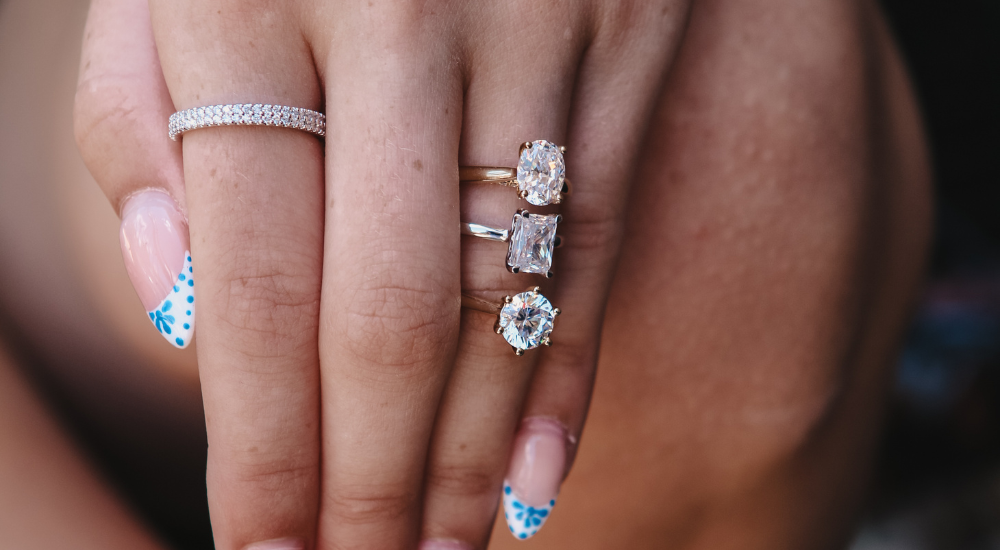
On the hand, round diamonds have a balanced, centered presence. They don't elongate the finger the way fancy shapes do, but they have a timeless symmetry that many people find exactly right.

Oval
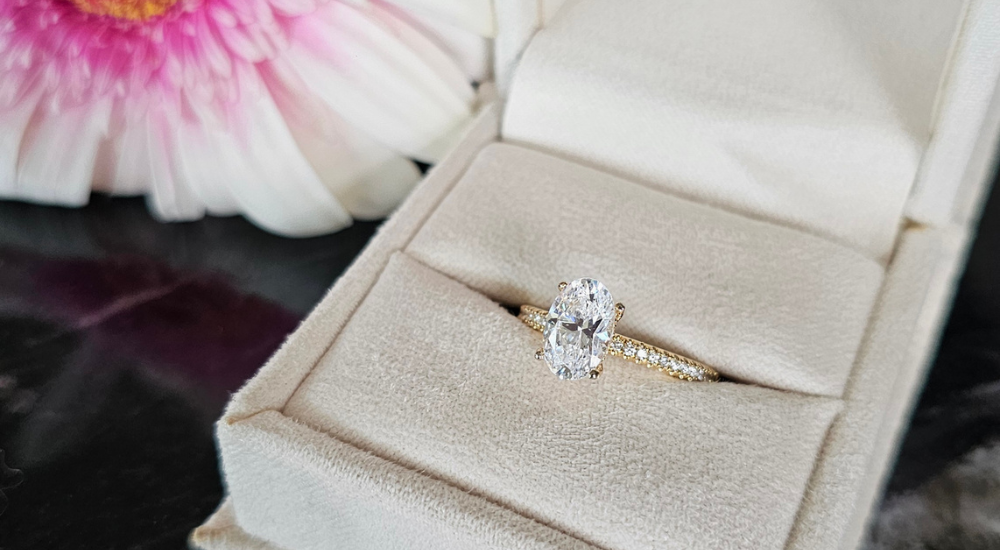
Something significant has been shifting in the engagement ring world. For generations, the round diamond held an unchallenged lead — but the oval has been closing that gap steadily. According to The Knot's 2026 Real Weddings study, oval diamonds are now chosen by 25 percent of couples, nearly matching rounds at 26 percent. For a shape once considered a less conventional choice, that's a meaningful shift.
The appeal is easy to understand. Ovals are cut in the same brilliant style as rounds, with a similar facet structure and comparable light performance — but with a distinctly elongated, modern look. The surface area of an oval diamond is roughly 30 percent larger than that of a round at the same carat weight, which means ovals tend to read larger on the hand without a larger price tag.
On the finger, the elongated shape creates a lengthening, slimming effect that suits most hand types well. One thing worth knowing: if an oval is cut without care, it can show a shadowed "bowtie" across the center that diminishes its sparkle. A well-cut oval minimizes this entirely. When you come in, we're happy to show you the difference side by side.

Pear
A pear-shaped diamond — sometimes called a teardrop — combines the rounded base of an oval with a single pointed tip. It's one of the oldest diamond shapes, with origins in the 1400s, yet it continues to feel current in the right setting.
One of the pear's most notable qualities is how it wears. Set with the point toward the fingertip, it creates one of the most pronounced elongating effects of any diamond shape, making fingers appear longer and more slender. Pear diamonds also tend to look larger than their carat weight suggests, for the same reason ovals do — the elongated outline spreads weight across a wider surface area.
Style-wise, pear diamonds suit vintage-inspired settings particularly well, and they've become a favorite for east-west orientations, where the stone is set horizontally across the band for a less expected, more personal look.

Princess
The princess cut is the most popular square diamond shape, and it holds that distinction for good reason. Unlike many fancy shapes, princess cuts are faceted in a brilliant style, which gives them strong light performance — more so than most other square or rectangular cuts. Their sharp corners and geometric lines give them a crisp, modern quality.
On the hand, princess cuts have a structured, confident presence. Because of their square outline, they tend to read slightly larger face-up than a round diamond of the same carat weight. One practical note: the pointed corners are the most vulnerable part of the stone, so a setting that offers some protection — such as a prong or bezel that covers each corner — is worth discussing with your jeweler.
Emerald
The emerald cut is defined by its long rectangular outline, cropped corners, and parallel step-cut facets. It doesn't produce the kind of bright, scintillating sparkle that brilliant cuts are known for. Instead, it creates a deep, glassy play of light — broad flashes rather than sharp fire — that reads as refined and composed.
This is a shape that rewards quality in the stone itself. The open, mirror-like facets make color and clarity more visible than in most other shapes, so both matter more in an emerald cut. That's useful information to have before you shop, not a reason to avoid the shape. We'll help you find a stone where those qualities genuinely show.
On the hand, the emerald cut has a long, lean presence. It's particularly well-suited to guests drawn to clean architectural lines, art deco design, or a more understated kind of elegance.

Cushion
The cushion cut sits somewhere between the round and the princess — square or slightly rectangular, with softly rounded corners and a silhouette that feels warm and considered. It's one of the oldest diamond shapes in existence, and that history gives it a depth of character that newer cuts sometimes lack.
Modern cushion cuts come in two distinct styles: the classic cushion, with larger, chunkier facets and a softer glow, and the modified cushion, with a more brilliant, crushed-ice sparkle. They look quite different from one another, and the distinction is worth experiencing in person before making a decision.
On the hand, cushion cuts have a softer feel than princess cuts, with none of the sharp edges. They pair well with vintage settings, halo designs, and solitaires alike — a versatile shape for guests who want a square or rectangular outline without sacrificing warmth.
Radiant
The radiant cut takes the outline of an emerald — rectangular with cropped corners — and applies a brilliant-style facet pattern beneath it. It was one of the first fancy shapes designed specifically to maximize sparkle in a non-round diamond, and it succeeds at that.
One characteristic worth understanding: radiants have a deeper pavilion than oval or pear shapes, which means more of the diamond's weight sits below the surface. This can make them appear slightly smaller face-up than elongated fancy shapes of the same carat weight. Size on the hand and sparkle are both worth considering together when comparing stones.
On the hand, the radiant has a bold, structured presence. It pairs particularly well with tapered or straight baguette side stones, which complement its clean geometry.

Marquise
The marquise is one of the most recognizable diamond shapes — long and narrow, with two pointed ends that come together in an elongated oval form. It has a storied history, reportedly commissioned by King Louis XV of France in the 18th century, and it carries that sense of drama and distinction with it.
After a long stretch in the background, the marquise has made a genuine comeback. Selena Gomez's marquise engagement ring brought widespread attention to the shape when Benny Blanco proposed in late 2024, and interest has continued to build since. It's a shape that rewards people who want something with real presence and personality.
On the hand, the marquise is arguably the most elongating of all diamond shapes. The pointed ends draw the eye along the length of the finger, creating a lengthening effect that's more pronounced than even an oval or pear. Marquise diamonds also tend to look larger than their carat weight suggests, because the elongated outline maximizes face-up surface area. For guests who want a stone with real visual impact, that combination is hard to overlook.
One thing to know: like ovals and pears, marquise diamonds can show a bowtie shadow across the center if the cut isn't well-executed. A well-proportioned marquise will minimize this. It's worth seeing a few side by side — we're happy to walk you through what to look for.

Other Diamond Shapes
Among the less common shapes: asscher, heart, and trillion each have their own character and following. The marquise, in particular, has seen a genuine resurgence — its elongated, pointed outline offers one of the most dramatic finger-lengthening effects of any shape, and its presence reads larger than its carat weight. Like most things in design, diamond shapes move through periods of wider and narrower appreciation. What feels distinctive today can easily become a signature look.
Come See Them in Person
If you're not sure where to start, that's entirely normal — and honestly, the most useful thing we can say is that these shapes need to be seen on your hand to really understand. Something that reads one way in a photo can feel completely different in person.
Our team at Koser Jewelers has been helping guests find the right diamond since 1952. We'd love to be part of that process for you. Stop by or give us a call at 717-653-4941.